
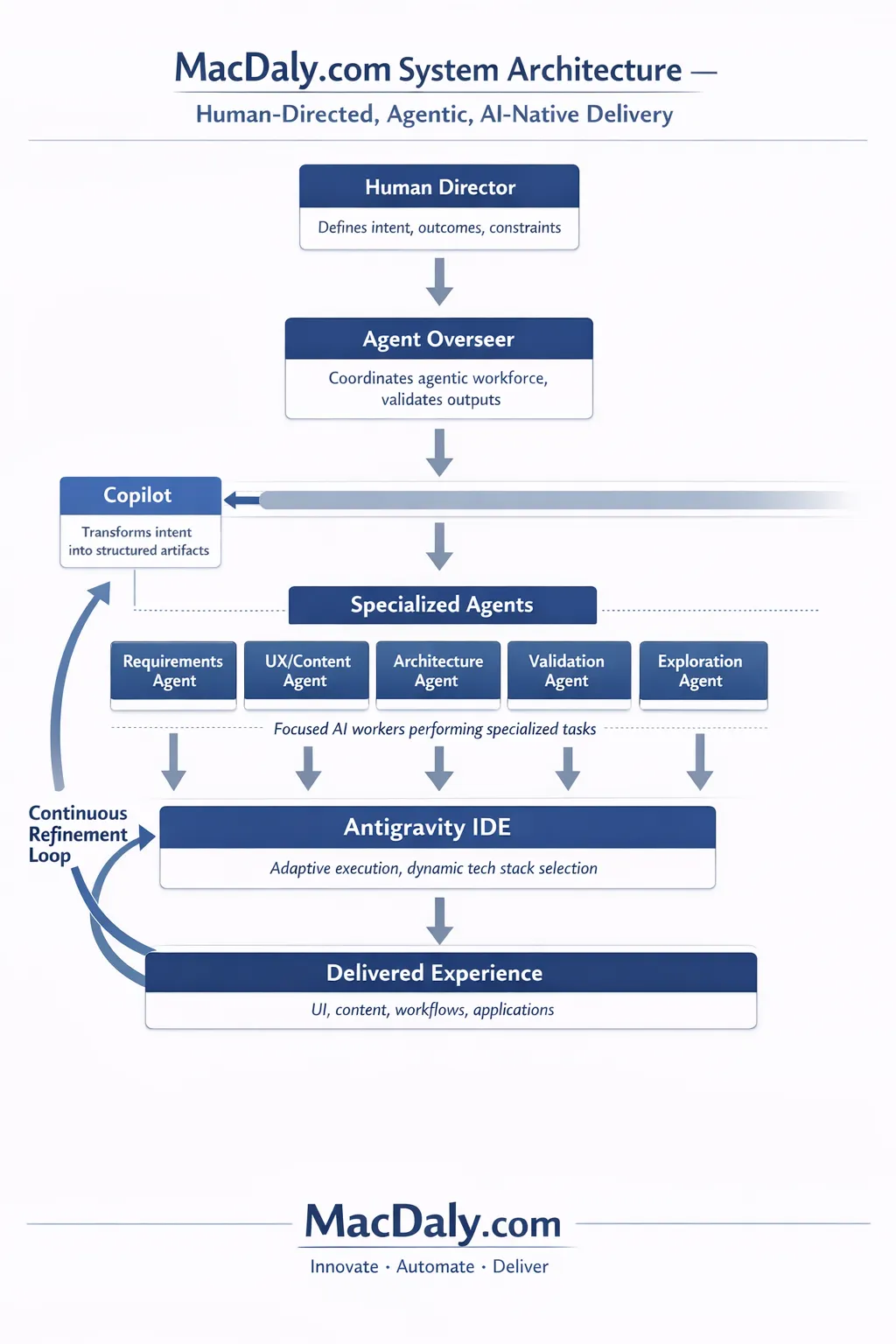
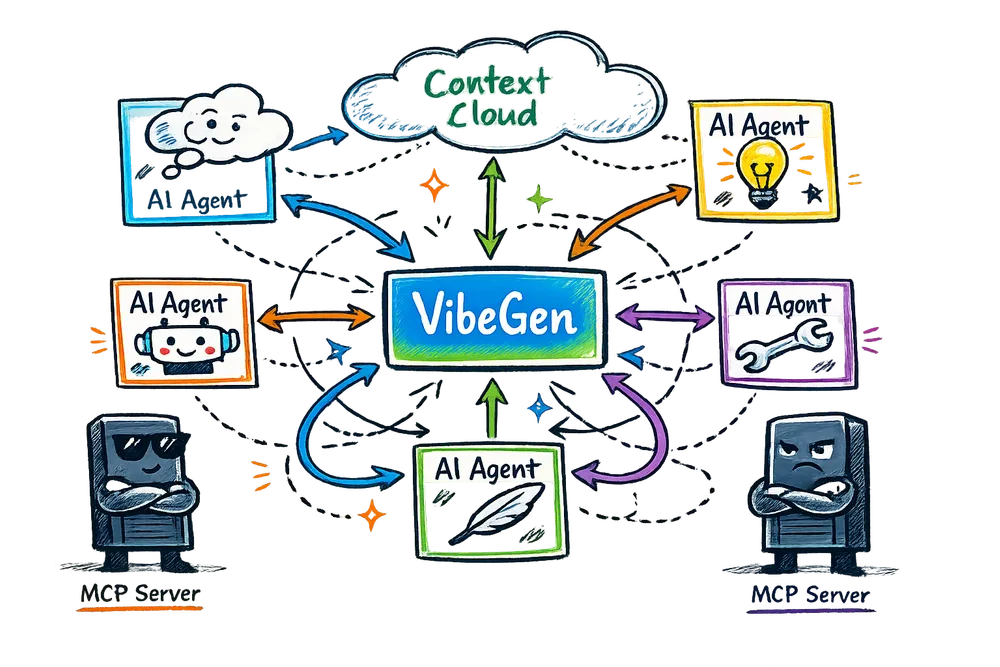
Artistic Credit co-authored by Copilot & Keith
Introduction
There’s a moment every builder hits when working with AI systems — a moment where you realize you’re no longer steering the ship so much as negotiating with it. For me, that moment arrived somewhere in the middle of building VibeGen, when I found myself genuinely “turned around” trying to keep the context, orchestration, and agent interactions straight.
Not confused. Not overwhelmed.
Just… turned around.
Like walking into a room and forgetting why you’re there, except the room is a multi-agent architecture diagram and the reason you’re there is because you built it.
The Day the Context Won
VibeGen started as a clean idea: modular, persona-aware, multi-turn generation with a clear workflow. Simple enough. But as the system grew — scaffolding UI, state models, pipelines, and artifacts — the orchestration layer started behaving like a well-meaning but over-caffeinated project manager.
Every agent had context. Every context had sub-context. Every sub-context had a callback.
And suddenly I was debugging not code, but intent.
Trying to remember which agent knew what, when, and why felt like trying to keep track of who’s mad at who in a group chat.
This wasn’t a failure of design — it was a preview of a broader industry trend: AI systems are becoming complex faster than we’re becoming good at managing complexity.
The Architecture Diagrams Are Starting to Show It
If you’ve been watching the AI architecture diagrams circulating lately, you’ve probably noticed something: they’re starting to look suspiciously like value-stream maps from the early 2010s.
Boxes. Arrows. More arrows. A “context router” here. A “semantic memory layer” there. A “multi-agent arbitration loop” that looks like it escaped from a DevOps conference.
It’s not that these diagrams are wrong — they’re accurate.
But they’re also a sign that we’re drifting into a familiar trap: complexity disguised as sophistication.
And I say that as someone who has built systems that were actually complex.
A Quick Detour Back to ESBs
Before AI, I spent years designing and integrating enterprise service buses (ESBs). They were powerful, elegant in theory, and absolutely brutal in practice.
They were:
- Expensive
- Difficult to manage
- Prone to “mysterious behavior” (the polite term)
- And always one configuration away from a full-blown existential crisis
ESBs taught me a lesson I’ve never forgotten:
When the orchestration layer becomes the system, the system becomes unmanageable.
And I’m starting to see the same pattern emerging in AI.
Form vs. Complexity: The Balance We Haven’t Learned Yet
We’re entering a phase where AI systems are powerful enough to do almost anything, but not simple enough for humans to reason about intuitively. The industry is sprinting toward multi-agent orchestration, dynamic context graphs, and adaptive workflows — all good things — but we haven’t yet developed the instincts or patterns to keep them grounded.
We’re building systems that are:
- More dynamic than traditional software
- More interconnected than microservices
- More stateful than stateless architectures
- And more “opinionated” than any tool has a right to be
The result is a new balancing act:
How do we build AI systems that are powerful without becoming opaque? Flexible without becoming chaotic? Expressive without becoming exhausting?
This is the frontier we’re all standing on — and most people don’t realize it yet.
Where I Landed
My experience getting “turned around” inside VibeGen wasn’t a failure. It was a signal. A reminder that complexity isn’t a badge of honor — it’s a cost. And the next evolution of AI architecture won’t be about adding more layers, more agents, or more clever routing.
It will be about finding the right form.
A form that’s intuitive, navigable, and human-centered.
A form that doesn’t require a map, a compass, and a support group to understand.
We’re not there yet.
But we’re starting to see the edges of the problem — and that’s usually where the real breakthroughs begin.